The Medieval Monk

Blogum scribo

Picture
  • Welcome
  • What I do
  • Blog
  • Projects & Publications
  • Buy me a coffee
  • Contact Me

13/11/2014

Spinnin' an' a'weavin' (part two)

9 Comments

Read Now
 
Picture
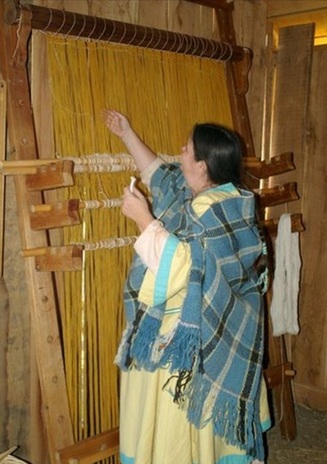
Chris at her loom. She transported the loom all the way from Oklahoma to Manchester UK when she studied for her MPhil. Now that's dedication! © Copyrighted Image: Christina Petty 2014

Time to confess, Christina Petty!  Has this amazing medieval textile expert ever cheated?  And what does she think of Hollywood's weavers 'n' spinners ...

Picture
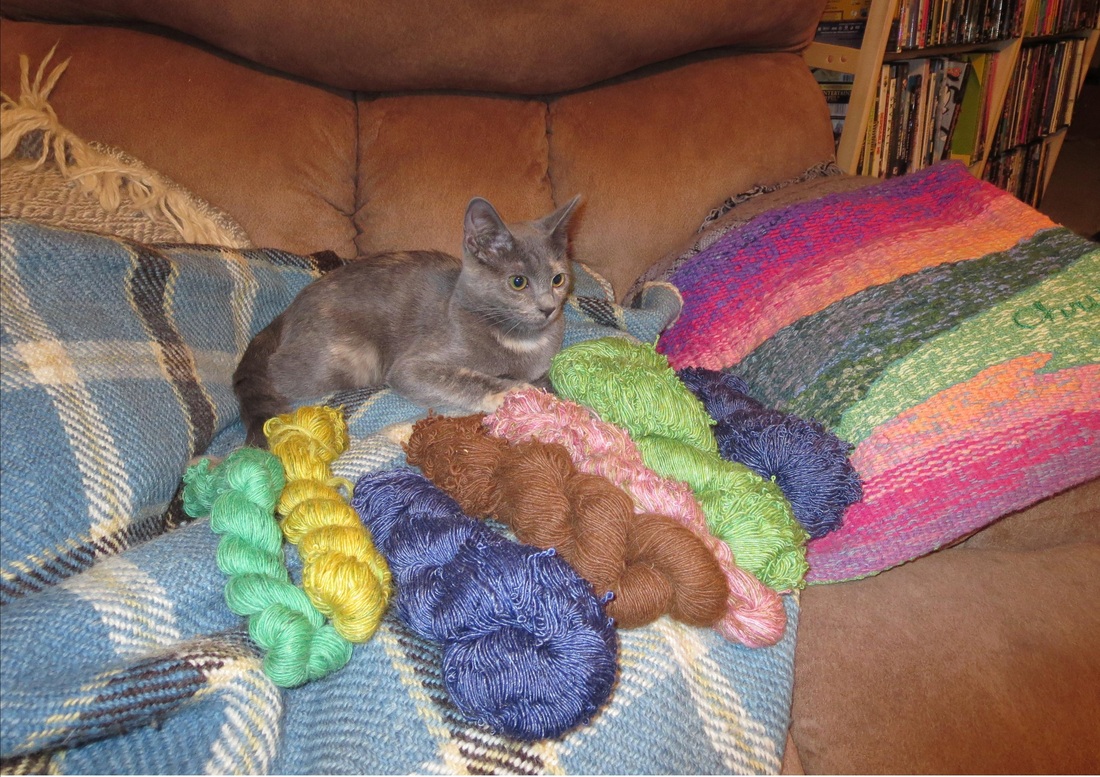
Chris's home-spun threads and her fabric produced on her own loom ... and her gorgeous cat! © Copyrighted Image: Christina Petty 2014
You may have missed part one of my interview with Chris Petty (rather careless of you), where she explains the processes of early medieval fabric production.

Before we get into part two, however, I just want to answer a query from @Huscarl1066, who wants to know what a niddy-noddy looks like.  Don't we all? 

Well, Chris very kindly has given us some links to a couple of images: Niddy-noddy 1 and Niddy-noddy 2.  (My monastic scruples over copyright issues will not allow me to reproduce the images directly on my website.)

Chris also tells me that the niddy-noddy helps you to 'put yarn into long, even loops that can be twisted around to make skeins for easy storage, or have enough space between the individual strands to allow for dyeing without it becoming a tangled mess'.

So there you go, @Huscarl1066, now you know what to do with your niddy-noddy!

I can see this taking off ... maybe I should start advertising my services on here: Get your new niddy-noddies now from the Anglo-Saxon Monk!

OK, I know ... I'm obsessed with the word niddy-noddy.  Six (now seven) niddy-noddies in one introduction.  Must be a monastic record.

---------------------------------------------


ASM: What have you produced yourself using early medieval techniques?  Do you ever cheat?


CP: I’ve woven four experimental pieces using different wools and patterns, with a fifth now on the loom, to see how the warp weighted loom behaved and how different configurations of the loom worked.

I generally only wear the plaid [that's 'check-patterned' to us British folk] mentioned earlier as a cloak. The rest of the fabrics are draped over furniture around my house as display items. They all do get taken to various lectures and re-enactment events as demonstration pieces.


I do ‘cheat’ with the spinning, though never with the dyes, depending on how much available time I have. I often use my spinning wheel to produce enough yarn when I have a time constraint, as it usually takes me 15-20 seconds to spin a yard of yarn on it, and I don’t have to wind the spun yarn off the wheel as often as I do with a drop spindle.

The end product is indistinguishable from something made with completely authentic tools and I still spun it myself by hand, so I feel that is a legitimate cheat.


ASM: If we were trying to imagine a typical Anglo-Saxon weaver or a spinner, who should we be imagining?

CP: Okay, imagine any female over the age of four or five. Got that? Now add in invalid men with good manual dexterity. There you have it – a typical spinner for early medieval Europe.

As far as we can tell, there were no societal boundaries to the activity, though the quality of fibres and tools may have varied, depending on social class.

Queen Asa, buried in the Oseberg Ship in the early ninth century in Norway, was interred with a golden drop spindle and several other pieces of weaving equipment for smaller, therefore likely more ornamental, pieces.

Other spindle whorls that are found in the archaeological record have been barely-shaped lumps of dry clay with no distinguishing markers, so would more likely have belonged to the lower classes.

Because of the enormous time investment, and the huge number of things that we as human beings surround ourselves with that are made of cloth, every available hand was needed so that they could spin as much as possible.


I can spin while I’m walking somewhere, so I’d imagine that would be what the average woman would do. Later medieval pictures show women with spindles tucked into their belts, ready to spin whenever the opportunity presented itself.

Walking with the goats, watching the children, talking with the neighbours, all could be moments to add a few dozen more yards of thread to the spindle. 

Dark presents no difficulties for a practiced spinner as after the first couple of years, the skill is all in the fingers, and you don’t have to watch what you are doing anymore.


Weavers are a lot harder to pin down, because there are fewer archaeological clues. Warp weights, the primary indicator of weaving activity, can and are found pretty much anywhere. Most of the Anglo-Saxon style warp weights are doughnut shaped, made of clay, sometimes fired into ceramic, sometimes not, and take the skill of a five year old to make.

The weavers mentioned in legend and myth do tend to be women, though Egil, from the Icelandic saga of the same name, is known to have done some form of textile work, because he’d learned that was a really good way to meet girls.

From a purely physical stand point, a weaver has to be able to lift between twenty five and seventy pounds with her triceps to move a heddle bar, which changes which threads are on the front of a piece and which threads are on the back.

Height may or may not have been a consideration, as the warp weighted loom is essentially a frame made of large sticks that can be made to size in fairly short order, though if a loom already existed it would be more likely to be used.

She would also have to be healthy enough to stand for hours because that’s how the loom is used. Being old enough to keep a pattern in her head and have the concentration to stay on task for hours is also a plus. So, I would imagine girls (for the most part – there was nothing keeping men from weaving) would be at least twelve before they were allowed to use the loom.


ASM: Thinking, then, about the way the medieval world is portrayed for entertainment purposes, particularly how weavers and spinners are depicted: Have you ever found yourself screaming at the TV (or, worse, vigorously protesting in a movie theatre) because they’re not showing it right?

CP: I have had – shall we say – criticisms about weaving, spinning, and costume in general when watching shows, though I can also set it aside. The grumbling tends to come later when my husband and I talk about the show. I have occasionally muttered about it in the theatre loudly enough to get a few looks, but I try not to disturb others.

I do find it very encouraging that the entertainment and documentary industries are at least coming to understand the historically appropriate tools to use.

I’ve seen Penelope in more recent versions of The Odyssey using an actual warp weighted loom, and know of a warp weighted weaver who was asked to set up several looms as part of a set for Biblical era Jerusalem. The lead actors have no idea how to use them, of course, but at least progress is being made.


ASM: What got you into medieval textiles yourself?

CP: I grew up in an extended family where fibre crafts were just part of what you did. I learned to tat (a lacemaking craft) at my great grandmother’s knee, and to crochet from my mother when I was eight.

My cousins and I would play under the quilting frame where the older ladies were working until we got old enough to reach the top of the quilt and could help. Sewing, embroidery, costume design for theatre … it has always been part of my life.


For the medieval part of the equation, I was a young mother with three small children when I started to wonder what medieval women did with their days. I figured spinning had to take up some of the time, so I found a woman in my church who could teach me. She started me on the drop spindle, which I didn’t know was a medieval tool at the time (spinning wheels are late medieval, and only became a household item around 1600).

Needing something to do with all the yarn I was spinning, I looked into weaving, taking classes in basic floor loom work and tapestry weaving. I kept poking at the craft, learning as much as I could find out, and eventually came across the warp weighted loom after I started my undergraduate work in my mid-thirties.

Then I made the serendipitous mistake of telling one of my professors about my interest. He and one of the other professors in the Humanities department brought a proposition to me in 2000. The university’s Medieval Society would pay for materials for a warp weighted loom that I could keep if I created and researched the loom, spun up enough yarn for a piece of fabric, and have the loom up and working for an educational display. Of course I said yes. What a research opportunity!


The catch was I had two months to do this, while keeping up with my studies, raising three kids, and helping my disabled husband. Three hundred and fifty hours of work and many sleepless nights later, I had my first loom set up working in time for 30,000 visitors to observe and ask questions about the weaving and the loom.

The rest, as they say, is history.

ASM:If someone wanted to get involved, what would you say to them?

CP: Firstly, a lot of people make the mistake that you have to be brilliant at something to attempt it. Relax! In textile work, it’s just string. We can always make more.

The first few pieces that you do are for making a spinner/weaver/dyer or whatever, which is valuable in and of itself. There are also things you can only learn by doing, and crafts of any sort can be deeply satisfying.


Secondly, with the internet we are now a group of craftspeople with international connections. Contact someone you think might be able to help you find out what you want to know. (I’m easily approachable, for example.)

Chances are there is someone close to where you live that can help you or at least point you in the right direction. The internet also has the advantage of videos that can remind you of what you have learned, and expand on your skills.

I recommend learning from someone in person first, however, as these are three dimensional skills, and a teacher can correct mistakes or suggest alternate solutions if a movement is difficult.


Textile history is comparatively new in the academic world, and we can use all the help we can get! 

-----------------------------------------------------------------------

Chris has very kindly provided a link to her MPhil thesis: Warp Weighted Looms Then and Now: Anglo-Saxon and Viking Archaeological Evidence and Modern Practitioners


I can spin while I’m walking somewhere, so I imagine that's what an Anglo-Saxon woman
would have done. 
Walking with the goats, watching the children, talking with the neighbours,
all could be moments to add a few dozen more yards of thread
to the spindle.


The weavers mentioned in
legend and myth do tend to be women, though Egil, from the Icelandic saga of the same name,
is known to have done some form of textile work, because he’d learned that was a really
good way to meet girls.


I know of a warp weighted
weaver who was asked to set up several looms as part of a set for Biblical era Jerusalem. The
lead actors have no idea how
to use them, of course, but
at least progress is being made.


A lot of people make the
mistake of thinking you have to be brilliant at something to
attempt it. Relax! In textile work, it’s just string. We can
always make more!


Picture
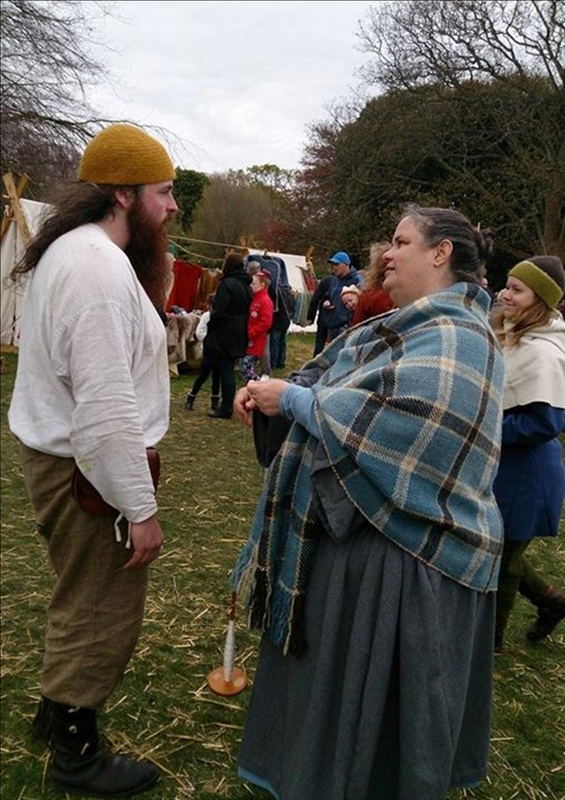
Chris spinnin' an' a chattin' at Clontarf. © Copyrighted Image: Christina Petty 2014

Share

9 Comments

10/11/2014

Spinnin' and a weavin' (part one)

3 Comments

Read Now
 
Picture
Christina Petty received her MPhil from the University of Manchester (UK) in 2014. Her thesis was on the subject of Anglo-Saxon and Viking era warp weighted looms. She has 25 years experience in medieval textile creation, and is published in the Cambridge Encyclopedia of Dress and Textiles, The History of Oklahoma Journal, and several international trade magazines. She has lectured on and demonstrated the use of the warp weighted loom all over the world.

My friend Christina Petty, an Oklahoma girl, gives us some real insight into Anglo-Saxon textile production.  Now go get your spindle!

Picture
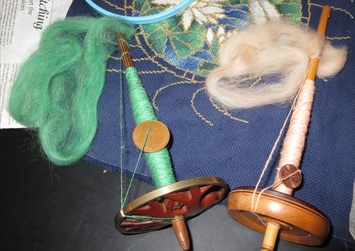
Two of Chris's spindles. © Copyrighted Image: Christina Petty 2014
I first met 'the other Chris' (as she was fond of calling herself) a few years back, not long after she had crossed the pond to England to start a postgraduate degree at the University of Manchester.  

I was intrigued not only by her subject of enquiry
– Anglo-Saxon and Viking era warp weighted looms – but also her approach to her research. 

And then there was that curious thing: what's a student of textile production doing in an English department?  Go figure, as Chris would say.  Well, let's allow Chris to do the talking ...

--------------------------------------------------
ASM: How should we go about reconstructing the history of Anglo-Saxon textiles?  Is there, for example, a conversation to be had between academic historians and historical practitioners, if that’s the right term?

CP: Historical practitioners is as good a term as any. Such individuals also do historical reproductions, and variants on experimental archaeology and museum education.

Reconstructing the history of Anglo-Saxon textiles is kind of like working with a jigsaw puzzle with a sizable number of pieces missing.

Since textiles, and the mostly wooden tools that made them, tend to disintegrate in British soil fairly quickly, the archaeological evidence tends to be small fragments.

We have over 4,000 textile fragments, many of which are oxidized replacements, created when the metal objects next to the textiles rusted. With few very notable exceptions, most of these textiles are less than two inches (5 cm) in size, so reconstructing the original item can be a particular challenge.


With textiles especially, interdisciplinary studies are required to get the whole picture, as you can never be certain where a useful piece of information can be found.

Because textiles are such an everyday sort of item – even now we don’t generally consider all the fabrics that surround us – little in the way of medieval literature about them exists, except in brief mentions, with no details, in documents such as tax records.

I have found hints and ideas in archaeology and art, of course, but it also helps to know a bit about genetics, linguistics, engineering, chemistry, and theology.

A post graduate course I took at the University of Manchester in Britain asked the class to make a list of all the different disciplines our area of study touched on. I had the longest list with thirty seven different academic disciplines that I have referenced in my work.

Textile researchers can be found in art, history, English, and literature departments. Those of us that work in this area have to be open to information from any source.


I think the best conversation we can have about the textiles and the processes that made them is by having academics observe, question, and learn from those people who actually understand the crafts required to create textiles.

While we will never be able to prove how our ancestors actually made cloth, such conversations will help narrow the focus to what is possible and what is highly unlikely.

I know from experience and from talking to many craftsmen of all levels of experience that they rely heavily on academic literature to understand Anglo-Saxon textiles.

They use this data to inform their research and practical application work. I should like to see academics return the favour by using the information that can only be gathered by actually creating a piece of textile and from having years of experience with the craft.

Sometimes what works in a thought experiment does not equate to the experience of the craftsman.


As an example, a colleague, Dr Katrin Kania, who is also a spinner, recently conducted a series of experiments involving spindle whorls for spinning.

She controlled the weight of the whorls, where they were placed on the spindle, the fibre to be spun, and how much time was allowed for spinning with each tool.

Her preliminary results show that it is the spinner and not the tool that determines the size and quality of the yarn spun.

This is counter to many articles on the topic which come to the conclusion that the weight of the spindle whorl controls the size and quality of the yarn. A historical practitioner was needed to rethink the idea.


I find that, in many cases, historical practitioners come up with questions that have not been considered before because of their hands-on experience.

They can also come up with answers that have more to do with the inconsistencies of human experience.

In one case, where a single brooch from the archaeological record had three textiles caught in the pin, many theories were put forward having to do with costume and personal style.

The simple answer, however, brought up at a conference by a person well practiced with spinning and weaving, was that it was likely the person dressing the body for burial accidently pushed the pin of the brooch through more layers of fabric than was traditional.

The dressing ‘error’ was never 'fixed' because the person working the pin was in grief and as the dead don’t tend to move too much, it may not have been noticed
.


ASM: What processes were involved (are involved) in Anglo-Saxon textile production?

The actual list of processes involved in making textiles hasn’t changed all that much from the Neolithic period until now. Even the terminology hasn’t changed very much. We have just mechanized it.

To make a piece of cloth from wool you need to:

Shear the sheep. This is generally done in the spring.

Skirt the fleece. This removes all the unusable wool: the wool that was too short, too matted, or too dirty to be spinnable.

Wash the wool. There is some suggestion that the sheep were run through a washing process before shearing, but I’ve never seen it done.

Dyeing can be done at this point, but there are several other places in the process it can happen, depending on the decisions of the craftsmen and the design of the finished cloth.

Card or comb the wool to straighten the fibres to make straighter, more even yarn, and to get any remaining vegetable matter out of the wool.

Spin the wool. Anglo-Saxons used a drop spindle, as the spinning wheel didn’t come to Europe until the early 12th century. This is the most time consuming step.

The yarn has to be taken off the spindle and skeined by using a tool called a niddy noddy, or wound into a ball using a nostepinne if the spinner wants to ply the yarn.

Most Anglo-Saxon textiles are made with singles, or yarn that has only one thread instead of several wound around each other, so plying is not generally considered for historic reproduction textiles.


Set the twist, which is basically allowing the wool to felt within the yarn. This is done by putting the skein in hot water and hanging it to dry. Weights are sometimes added to the skein as it dries to strengthen the yarn.

Dyeing can be done at this point, if it hadn’t been done previously.

Wind the yarn into a ball. This makes it easier to work with for the next step.

Measure the yarn for warp thread. Warp thread is attached to the loom and put under tension to make it easier to weave.

For the warp weighted loom, the primary weaving tool for northern Europe until about 1100 AD, there are two sets of warps that are measured.

The first set of warp threads can be put on some form of card loom, which is used to create both a reinforced border for the main piece of cloth, and at the same time arranges the spacing for the warp threads on the warp weighted loom.

This is much easier to explain in pictures or, preferably, in person because craft work is always easier to understand in three dimensions.


Wind yarn into cigar shaped balls for weft yarn. This happens often while actually weaving, as the weft yarn (the yarn that is woven into the warp threads) needs to be a small enough amount to work with – you can’t put a huge ball in between warp threads – and the weaver will need to make more of these balls to continue weaving..

Weave the cloth. This is the second most time consuming part of making fabrics.

Cut the fabric off the loom.

Finish the edges. The warp thread attaching the cloth to the loom is all just hanging threads at this point, so some form of edging needs to be decided upon, so that the weft doesn’t slide off the warp.

Edging can be tied tassels, different types of knots, or each warp thread can be woven individually back into the fabric with a needle. This process takes more time than you would think.


Dyeing can be done at this point, too.

Full the cloth.  At this point, the finished cloth is put into a bath of water, possibly washed or bleached, but certainly agitated so that the individual fibres can felt together making a cohesive piece rather than a collection of strings.

Stretch the cloth. This is to dry the piece and to make it uniform in tension with even edges and to counteract the rumpling that happens during fulling.

Tenter hooks were used in a frame in the later medieval periods, but we have no evidence that Anglo-Saxons used a frame. It isn’t particularly necessary, but it does make a more consistent sized cloth.


Twelve or so hours, depending on the weather, it would be dry, and is now a usable piece of cloth.

ASM: How labour intensive was it then to produce fabric?

CP: I will use my own numbers for the time it takes, because we have no reasonable idea about Anglo-Saxon spinners and weavers.

The only documented evidence comes from the late 1700’s in Sweden, when they used spinning wheels and water mill driven floor looms, which would not be accurate for drop spindles and warp weighted looms.


Keep in mind that while I am good at what I do in comparison to modern craftsmen, I’m just an interested hobbyist in comparison with the (mostly) women who did this as part of their daily chores.

It takes me about 30-45 seconds to spin a yard of yarn with my drop spindle, and about the same amount of time to throw a weft thread and beat it into place on my warp weighted loom.

Using these numbers I calculated out how long it took to make a small piece of plaid fabric (35 inches wide, two and a half yards long) that I spun and wove by hand.

The three miles of thread involved took me more than 1200 hours to spin and weave.

Setting up the warp weighted loom takes about another 16-20 hours.

Finishing the fabric with decorative knotwork took 100 hours.

Gathering and creating three different dyes from native plants takes another hundred or so hours.

So that piece took most of four months’ worth of eight hour days to complete. And this doesn’t include the time to wash or card the wool, and wind the yarns, which can take another several hundred hours to accomplish.


This being said, I don’t think Anglo-Saxon women thought about the work in hours and minutes like that. They would just do what they could on a given day, depending on how soon the cloth was needed, the light and the weather, and if the goat got loose or how the children were behaving.

--------------------------------------------------

Next week:

Find out if Chris ever cheats when she's making her own fabric, and what she thinks of Hollywood's depictions of medieval weavers and spinners
.


We have over 4,000 textile fragments, most of which are less than two inches in size, so reconstructing the original item is a particular challenge.


To study medieval production it helps to have a knowledge of genetics, linguistics, engineering, chemistry, and theology!


The best conversation we can have about textile production is to get academics to observe, question and learn from those who actually understand the crafts required to create textiles.


One burial brooch had three different textiles caught in the pin. Many theories were put forward but the simple explanation was that the person working the pin was grieving and the dead don't tend to notice.


The actual processes involved in making textiles haven't changed all that much from the Neolithic period until now.


Anglo-Saxons used a drop spindle: the spinning wheel didn't come to Europe until the early 12th century.


This is much easier to explain in person because craft work is always easier to understand in three dimensions.


One piece of fabric I made took me four months of eight hour days to complete!

Share

3 Comments

7/11/2014

I got my hands on it!  The Textus Roffensis, of course!

4 Comments

Read Now
 
Picture
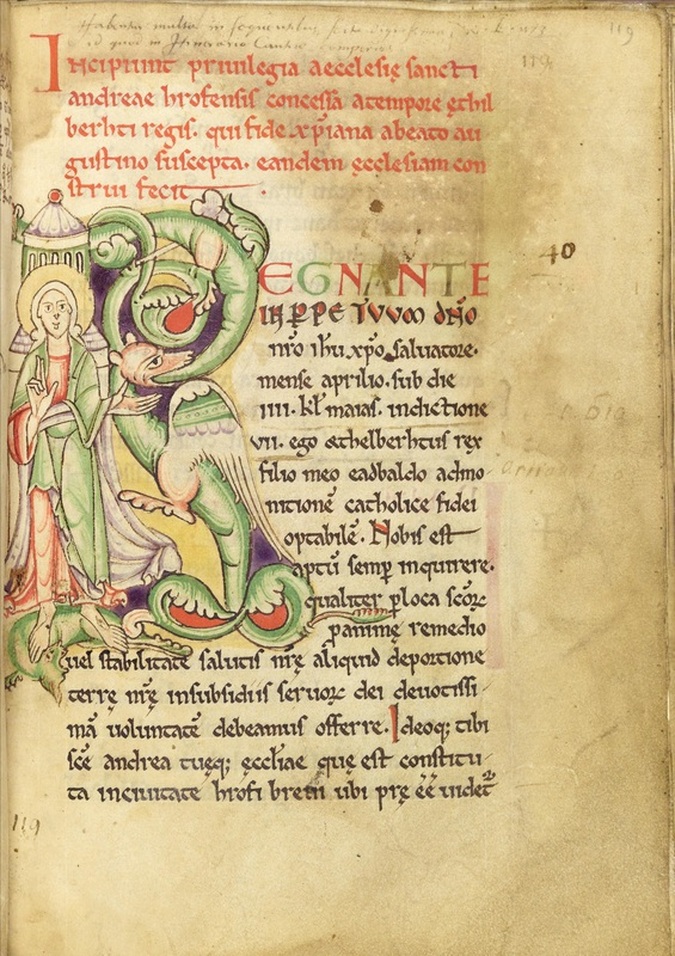
Textus Roffensis, folio 119r (Rochester, 1023/4). Press release image. Centre for Heritage Imaging and Collection Care, John Rylands Library.
Picture
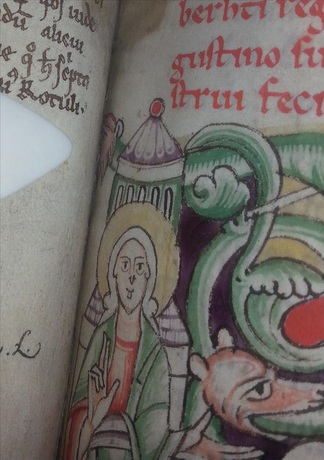
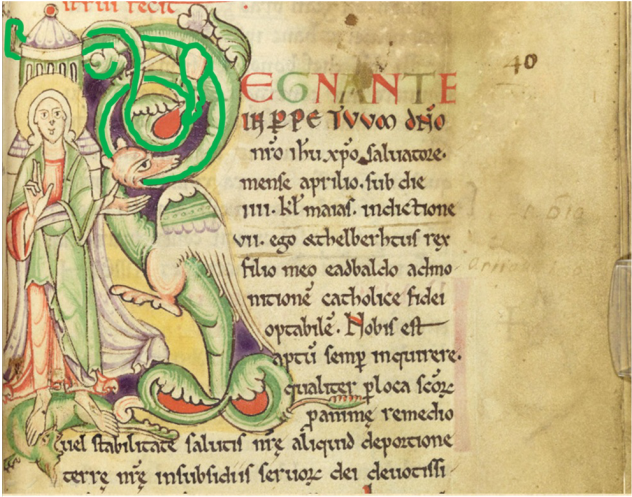
Textus Roffensis, detail of folio 119r: A head of a mythical beast occupies the page's gutter.

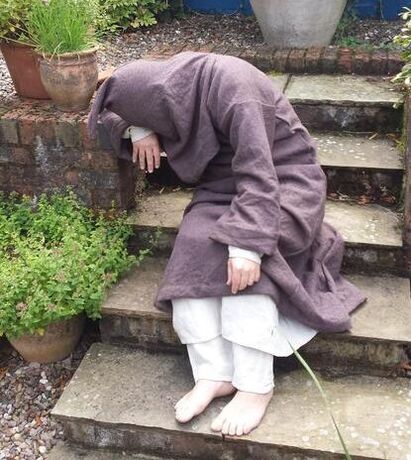
Pardon the excitement. I can't help myself. To actually get to examine the Textus Roffensis, the book that contains a unique copy of the oldest surviving piece of written English, which also happens to be the oldest English law, well ... it’s enough to make a monk remove his hood!

On Wednesday evening, whilst speaking at Rochester Cathedral about its wonderful Textus Roffensis, I managed to slip in a little appeal to be allowed to see the manuscript in the flesh. 

(It's actually in storage at the moment during the extensive renovation works being carried out on the cathedral’s crypt, where the Textus will go on permanent display next year.) 


I was explaining the significance of the illuminated initial 'R' (above), when I pointed out that even with the incredible digitised facsimile that is now available through the John Rylands Library, I couldn’t quite see the head of the beasty which hides in the gutter top left.

And I really needed to know!


Well, it just so happened that the archivist at Medway Archives & Study Centre happened to be in the audience.
And before I had time to say Textus de ecclesia Roffensi per Ernulfum episcopum, it was 
arranged for me to meet her the following morning.

The Keyholder!  She who, if I was really well behaved, would  unlock the pleasures of the Textus Roffensis for me.


Someone once said to me that trying to see manuscripts in one rather famous British institution (I dare not name it) was like getting past Grendel and his mother.  But, to my relief, Alison Cable was nothing like that.

It's true she did indeed have to retrieve the Textus from a secure safe – this book is insured for more than just a few Anglo-Saxon sceatts, you know – but once she had opened the medieval clasps of the binding, I was very kindly given an hour to salivate over it (mentally not literally).


I knew without a doubt that I just had to go straight to the folio with the decorated initial 'R'.  I was desperate to see the face of the beasty who forms the rounded part of the letter.  Well, with great care, we managed just that. 

It’s actually a strange, hybrid face.  It’s unlike the face and head of the dragon, who forms the leg of the 'R', though its ear is a similar shape (you might just be able to make out the ear in the photo above).  

The head is far shorter than the dragon’s, the face more human with its forked beard, and long side whiskers. 

It was possible to see a big eye, and, interestingly, what looks like a red-edged crest atop its head.

Ooh! What is this fascinating beasty?  I think I will call upon my longsuffering readers to provide me with suggestions. 

Take a look at my close-up photo (above), and also the basic shape of the beasty which I've traced out in green (below).

Leave a comment, not forgetting your answer, and then in a week's time, I will tell you what I think it is. 

(That's a way of saying I don't really know and I have to go away and do some extra research.)

Best answer gets ... a free sign of the benediction.

By the way, lots more stuff to come on the Textus Roffensis, including ten things you need to know about it, and links to my readings of some of its Old English (my native tongue).


What's that beasty whose head is in the page's gutter?


Would I get past the dreaded  Keyholder?


Insured for more than just a few Anglo-Saxon sceatts!


I could just manage to see its eye, a forked beard and what looked like a red crest on its head.


What is this fascinating 
and strange beasty?  I need your help.
 
Picture

Share

4 Comments

1/11/2014

An English treasure, a treasure of Englishness

1 Comment

Read Now
 
Picture
Rochester Cathedral. This image has been released by the copyright holder into the public domain.

This Wednesday I will be travelling to Rochester Cathedral to give a public talk about the cathedral's greatest treasure, the twelfth-century manuscript known as the Textus Roffensis.

It is without doubt one of the most important English cultural and historical treasures, and yet probably if you asked the general public to describe it, you would be met with blank faces and "never heard of it".

What makes it so important?  What exactly makes it a treasure?

If I were to point to just one thing, it would be that the Textus Roffensis symbolizes Englishness.

This is most clearly apparent when you open the codex to its first document:

'These are the judgements which King Æthelberht set down in Augustine's day' states the title.

So excited was the antiquarian William Lambarde when he first read this in 1573 that he got his pen out and wrote a message in the margin of the manuscript:  

'Place a high value on this book whoever you may be who come upon it!'

Lambarde knew what he was talking about, even if he was a bit free with his pen.  

He was actually an expert on ancient  English laws, having published a collection of Anglo-Saxon laws five years earlier, and yet he must have assumed Æthelberht's law was lost forever. 

He'd certainly read about it in the famous eighth-century Historia Ecclesiastica, written by Bede, but he'd never clapped his eyes on it.

You can almost feel his excitement when he wrote:

'These are the very laws that Bede reports were still around in his time!  But I'm not aware that another copy of them is in existence anywhere!'

He was right.  The Textus Roffensis does indeed contain the only surviving copy of the oldest English law, written in English (not Latin, which came to dominate legal writings after the Norman Conquest), and written  more than 1400 years ago!

We might say, then, that the Textus Roffensis represents the conception of Englishness.

There is so much more to say about this remarkable book.  This post is really just a taster.

And the really great thing is that we will all soon be able to re-live William Lambarde's experience of turning the pages of the Textus Roffensis.

On Wednesday, Rochester  Cathedral will launch the digital 'turn-the-pages' facsimile of the codex, and to celebrate it I've been asked to give a public talk on this amazing treasure of Englishness.


My talk on Wednesday is being filmed so I will in due course be providing a link to the film. 


You've heard of the Magna Carta and the Domesday Book.  But the Textus Roffensis?


If you asked the general public, they'd probably say "never heard of it".


So excited was Lambarde at what he'd discovered, that he took his pen and wrote a message in the margin of the manuscript!


The oldest English law, written in English, not Latin, and written more than 1400 years ago!


The
Textus Roffensis represents the conception of Englishness.

Share

1 Comment
Forward>>
Details

    Author

    Welcome, blessed readers! This is the blog of the Medieval Monk, the alter ego of Dr Christopher Monk.

    Archives

    April 2025
    July 2024
    June 2024
    August 2023
    March 2023
    December 2022
    November 2022
    September 2022
    July 2022
    April 2022
    February 2022
    October 2021
    June 2021
    March 2021
    February 2021
    December 2020
    August 2020
    July 2020
    June 2020
    May 2020
    March 2020
    February 2020
    January 2020
    September 2019
    August 2019
    March 2019
    February 2019
    December 2018
    November 2018
    September 2018
    August 2018
    July 2018
    June 2018
    May 2018
    April 2018
    March 2018
    February 2018
    January 2018
    December 2017
    November 2017
    October 2017
    September 2017
    August 2017
    July 2017
    June 2017
    May 2017
    April 2017
    March 2017
    February 2017
    January 2017
    December 2016
    November 2016
    October 2016
    September 2016
    August 2016
    July 2016
    June 2016
    May 2016
    April 2016
    March 2016
    February 2016
    January 2016
    December 2015
    November 2015
    October 2015
    September 2015
    August 2015
    July 2015
    June 2015
    May 2015
    April 2015
    March 2015
    February 2015
    January 2015
    December 2014
    November 2014
    October 2014
    September 2014
    August 2014
    July 2014
    June 2014

cookieassistant.com
Proudly powered by Weebly
  • Welcome
  • What I do
  • Blog
  • Projects & Publications
  • Buy me a coffee
  • Contact Me